If you spend as much time as I do staring at high-resolution monitors and tweaking the luminosity of a sunset, it’s easy to forget that photography was originally meant to live on a wall, not just appears in a social media feed waiting for a “like”.
I was given the opportunity to “take my work offline” for a month-long exhibition at the Cowan Creek social center here in Sun City, Georgetown, which will run through the month of April 2026. As a camera club, we have a series of walls in this center available for hanging prints and we have a rotating gallery where members get to take over about 44 linear feet of that wall space. It isn’t a high-stakes museum gala, but it is an excellent exercise in something every photographer should try – seeing your work at scale.
The 19-Foot Puzzle
The biggest challenge of any physical show is actually a mental one. I have 23,000 images that were judged of sufficient quality to be placed with stock photography agencies such as Getty and Adobe and I have about 3000 of those that I judged would make interesting prints and they are available in my main portfolio at SteveHeap.com. These walls could take 20 small prints or 15 in my case as I decided on a mix of materials and sizes – large-format acrylics, high-gloss metals, and traditionally framed 20×16 paper prints. And so choosing just 15 images from my portfolio took a lot of thought. I went for subjects that would interest and perhaps fascinate people using the social center and also had a bit of a slant towards local imagery that I had taken since moving to Texas 18 months ago.
Decisions made, I faced challenge number two! With five separate walls including a long 19-foot feature wall, how could I display these prints to make a pleasing display?
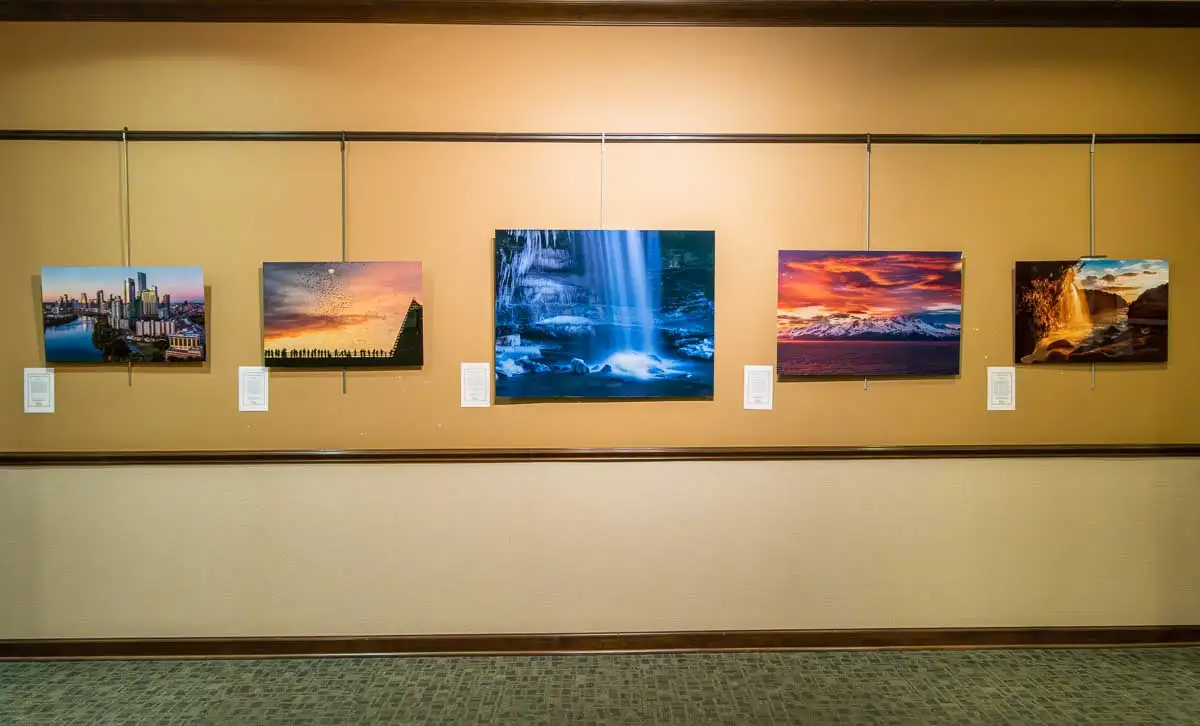
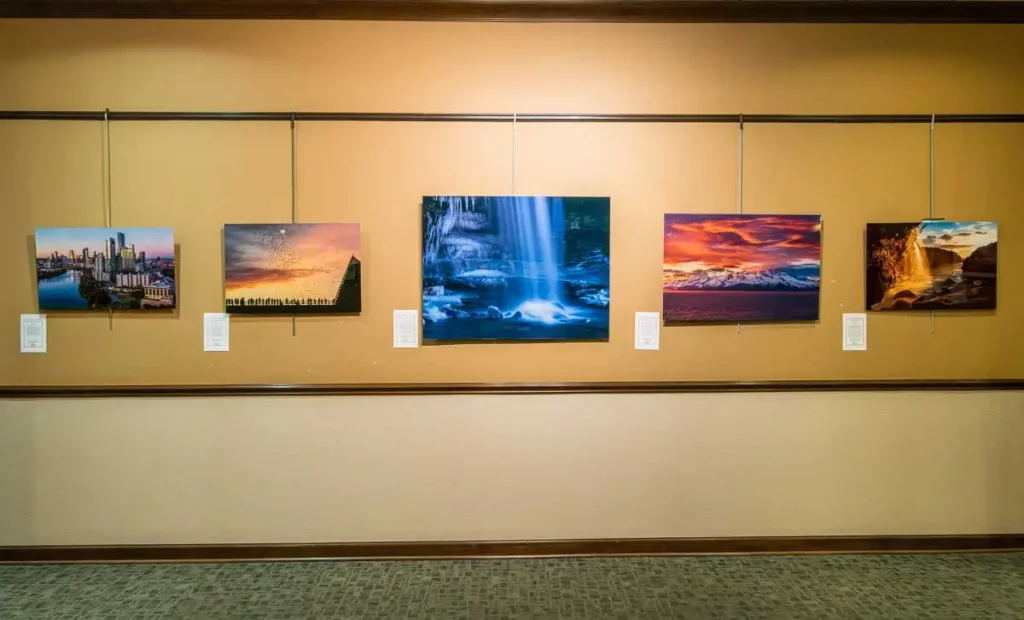
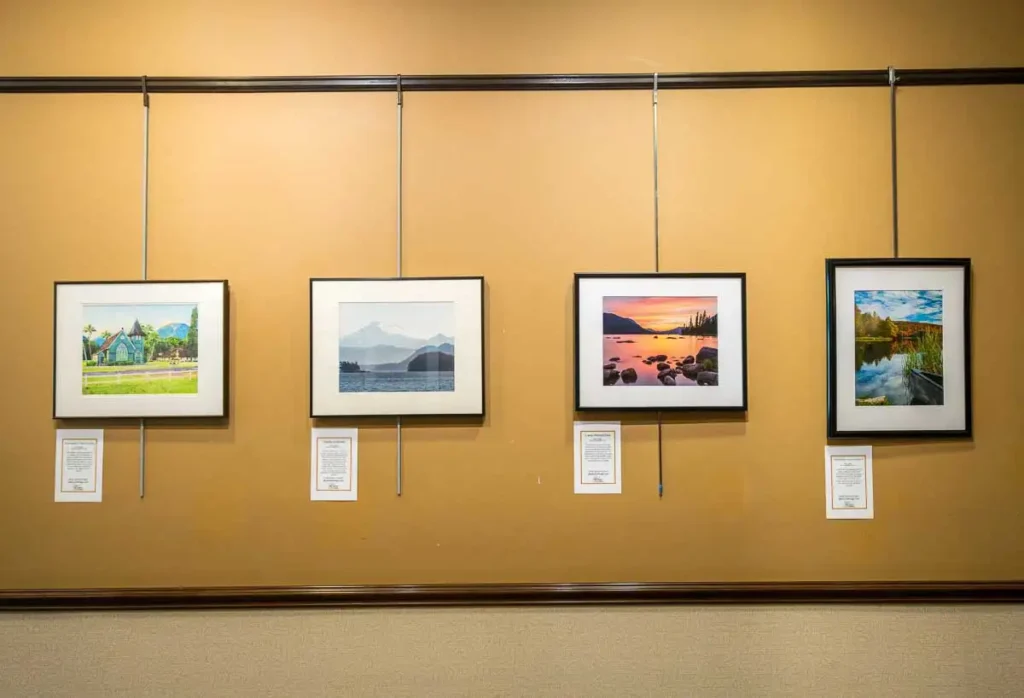
Initially, I tried a mixed arrangement focusing on similar subjects, but it felt a bit “higgledy-piggledy.” There’s a psychological difference between how we view a grid on Instagram and how we view a physical wall. On a wall, the eye looks for a horizon. I eventually settled on a “Peak” design for the main gallery, anchoring the center with my largest piece—a 40-inch acrylic of Cucumber Falls—and letting the rest of the collection descend in height toward the edges. All of the pieces in this area are large scale with the smallest being a 20×18 inch metal print of the 2026 Austin Skyline devoid of cranes!
The 66-Inch Rule: Finding the Horizon
One question I’m often asked is, “How high should I hang this?” Whether you are hanging a single piece in a living room or a 7-piece gallery like this one, the secret is the 66-inch center line. By aligning the horizontal center of every piece—regardless of whether it’s an 18-inch metal print or a 30-inch acrylic—you create a consistent “horizon” for the eye. This is what prevents a wall from feeling cluttered and gives it a professional gallery feel. It’s not about where the top of the frame sits; it’s about where the heart of the image meets your gaze.
Metal vs. Acrylic: Choosing the Right Finish
Seeing these pieces side-by-side on the wall highlights why I choose specific finishes for different subjects. For the Crane-Free Austin 2026 panorama and the Austin Bats at Sunset, I chose high-gloss metal. The way metal handles sharp, architectural lines gives the city a modern, luminous energy that feels almost three-dimensional. It can handle both deep blacks and brilliant highlights far better than any other material.
In contrast, the Fairweather Glow (captured from a cruise ship in Glacier Bay) and the Cucumber Falls pieces are large-format acrylics. Acrylic adds a sense of depth and a “wet” look to water and ice that is simply unmatched. It creates the sensation of looking through a window into the scene rather than just looking at a print.
A Moment in Time: The 2026 Austin Skyline
I have been photographing the Austin skyline since arriving here in the summer of 2024 and I find it a very attractive cityscape. But every time I visited, the skyline was dotted with cranes and partially constructed buildings. Many people don’t realize at first that the construction cranes that have dominated our skyline for years are finally gone. This project was about capturing that rare, “final” form of the city. Seeing it at a 30-inch scale on metal makes that architectural milestone feels permanent—it’s no longer just a digital file, but a piece of local history.
Beyond the Main Wall: Curating the Collection
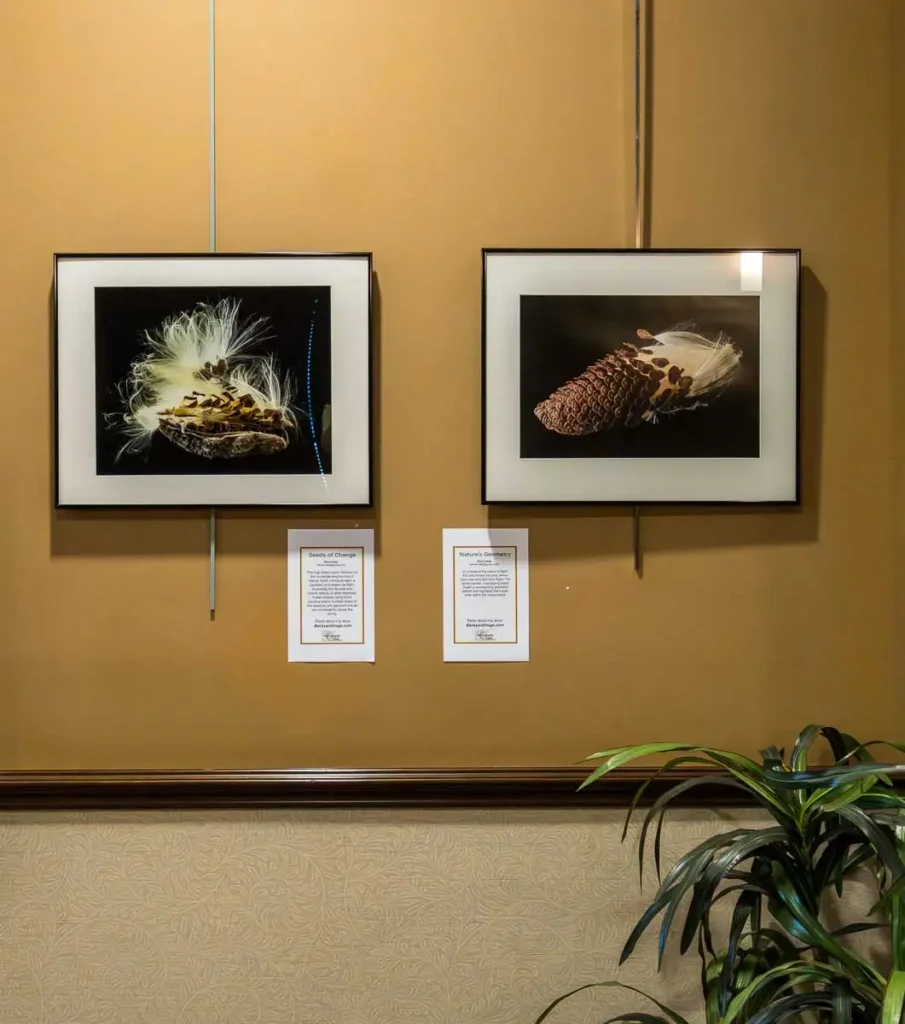
To keep the exhibition cohesive, I redistributed the ten identical 20×16 frames to the secondary walls and hallways. By grouping these uniform frames together, the visual “noise” of mixed materials disappeared. This allowed the individual stories—from the Gothic ruins of St Dunstan in London to the macro geometry of milkweed seeds—to speak for themselves. The transition from the massive urban panoramas to these intimate nature details provides a nice rhythm for anyone walking through the space.
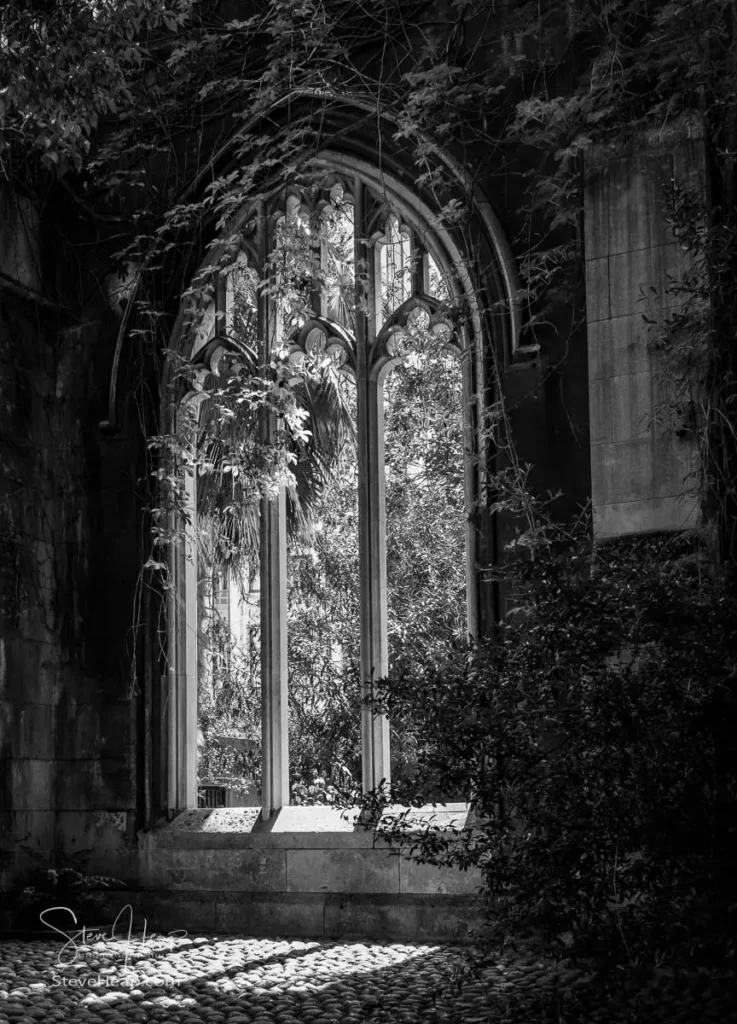
Incidentally, the black and white rendition of the gothic window of St Dunstan in the East church in the City of London has its own wall, but it also has a unique story.
Tucked between the glass towers of London’s financial heart lies the skeletal remains of a church whose history is as much about resilience as it is about ruin. Originally constructed around 1100, the church first fell victim to the Great Fire of London in 1666. It was patched up and eventually gained its iconic gothic spire, designed by Sir Christopher Wren; legend has it that Wren was so confident in the tower’s stability that he claimed it wouldn’t budge even if a storm leveled the rest of the City.
While Sir Christopher Wren’s steeple remained legendary for its strength, the main body of the church did not fare as well. By the early 19th century, it was discovered that the weight of the roof was actually pushing the nave walls outward, causing them to bow dangerously.
This structural failure led to a massive reconstruction between 1817 and 1821. The architect David Laing was brought in to oversee the project, effectively pulling down the crumbling structure and rebuilding the nave in a neo-Gothic style that matched the aesthetic of Wren’s tower.
However, the church’s greatest tragedy arrived in 1941 during the Blitz, when a direct hit from a German firebomb gutted the interior, leaving only Wren’s stubborn tower and the outer walls standing. Rather than rebuilding a third time, the City of London allowed nature to take the lead in 1967, transforming the ruins into a public garden. Today, it stands as a hauntingly beautiful sanctuary where ivy climbs through empty gothic windows and the echoes of the Blitz are softened by the rustle of trees, offering a rare, green “memento mori” amidst the rush of the modern metropolis.
Continuing the flow of the Gallery
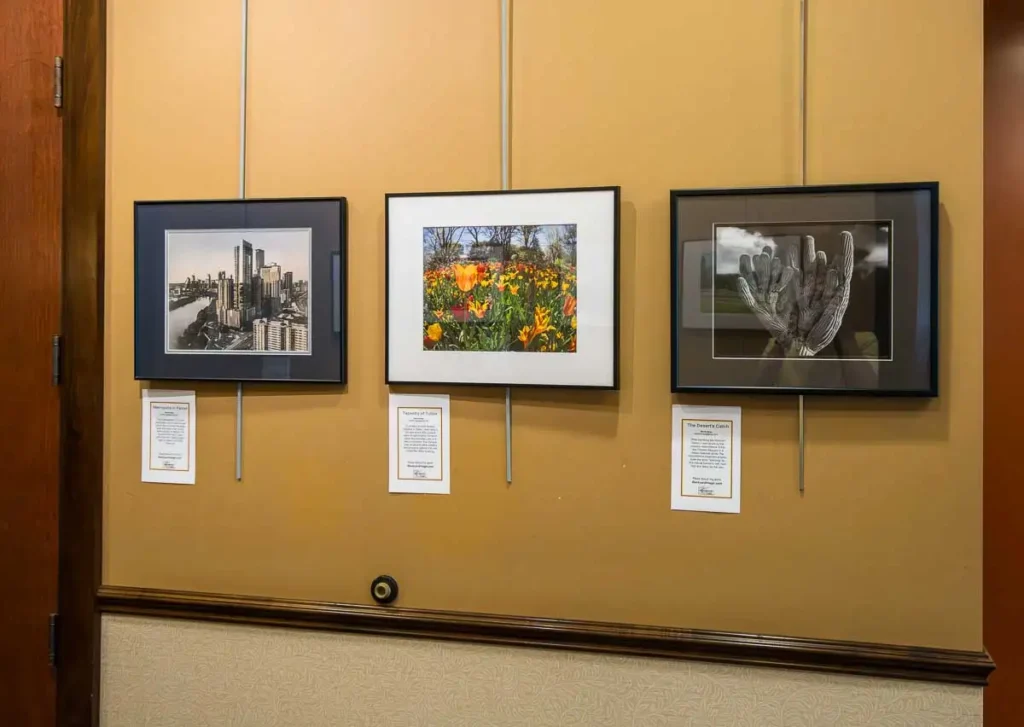
The final two walls house a collection of my favorite image and showcase different styles including a couple of digital painting effects, one of which is a charcoal/pastel rendition of those crane free massive towers in downtown Austin and a calmer watercolor painting of a famous and well-loved green church in the small town of Hanalei in Kauai.
Bring the Gallery Home
While this collection is currently living on the walls of the Cowan Creek social center, each of these pieces was designed to transform a living space. There is a finality to printing that you just don’t get online; there’s no “undo” button once the hook is in the wall.
If you’ve wondered how a large-scale metal or acrylic print would look in your own home, I invite you to browse this gallery if at all possible and then, perhaps, check out my full collection in my online gallery. All the prints can be delivered securely to your home with no shipping charges.