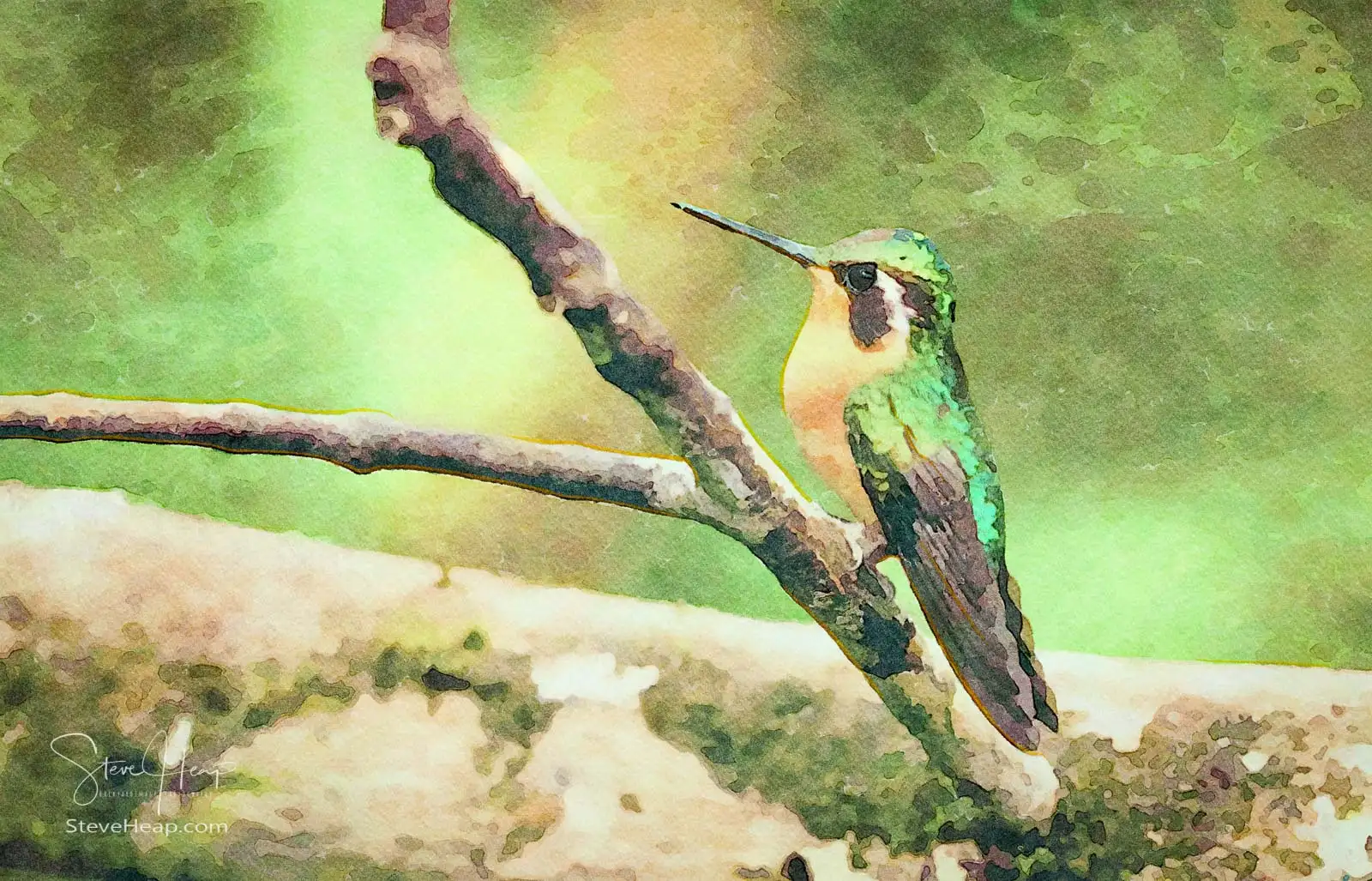
That is a very broad title above! And I cannot even try to convince you that I have seen anything more than a tiny fraction of these fascinating little birds during our wet visit to the Monteverde Cloud Forest. I was a little disappointed by our vacation in Costa Rica, mainly because the almost continuous rain kept many colorful birds and animals hidden from sight, but the two times we had a chance to see hummingbirds up close was a high spot! Of course, the white-faced capuchin monkeys were the other delight for me.
In this article I thought I would simply go through the hummingbirds that I managed to photograph, with a little more detail about what type it was and its habitat. Both locations were close to Monteverde, one a spot very near the cloud forest where many feeding tubes were available to attract the birds, and the second in the El Establo Mountain lodge we used as our base in the area.
Violet Sebrewing Hummingbird
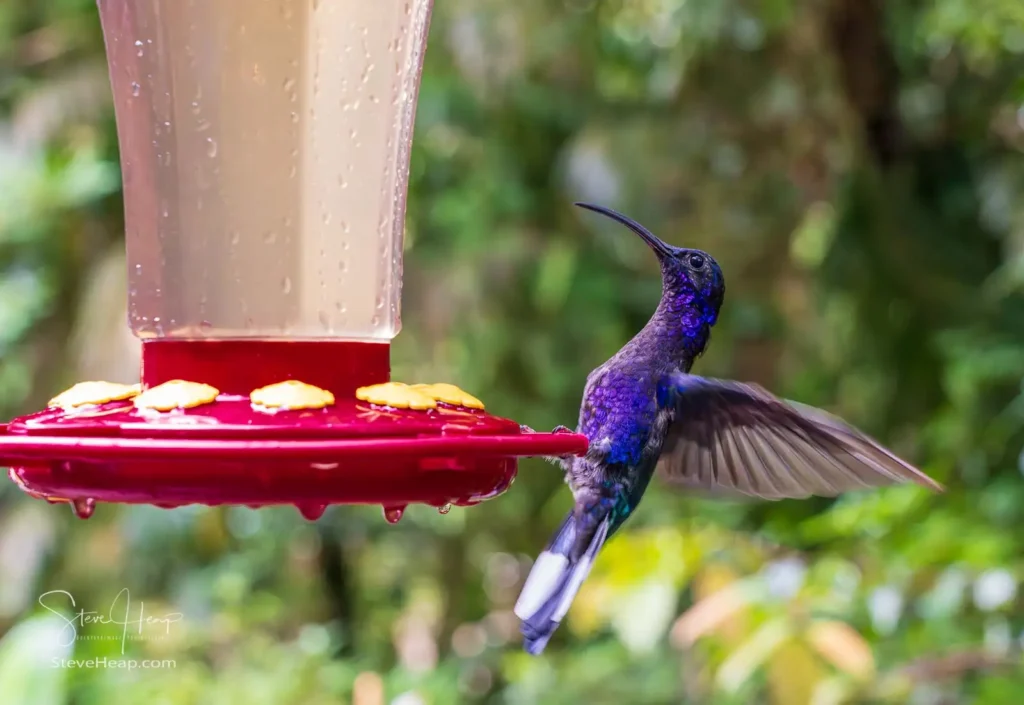
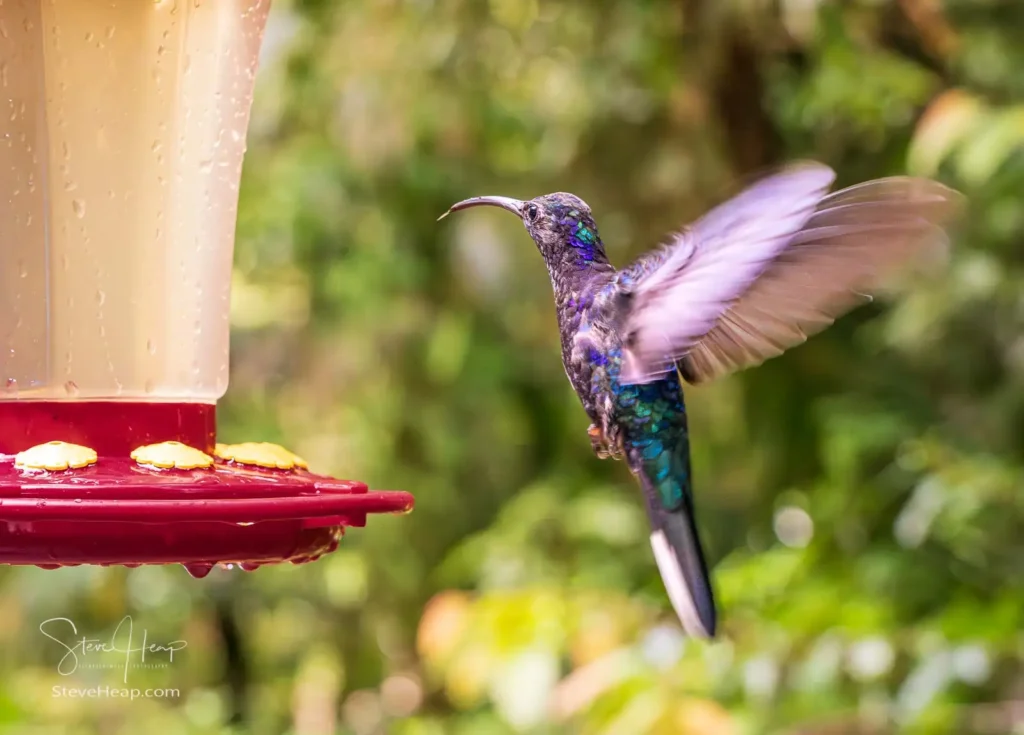
The hummingbird in the image is a male Violet Sabrewing (Campylopterus hemileucurus), the largest hummingbird species found in Central America.
Key Characteristics
- Coloration: The male has vibrant, iridescent deep violet and blue plumage across most of its body. Its back and wing feathers are dark green.
- Tail: A key identification feature is the long, black tail with white edges or tips on the outer feathers, which is visible in the image.
- Bill: It possesses a long, black, and slightly down-curved bill.
- Size and Habitat: They are relatively large for hummingbirds, roughly the size of a sparrow. They are common in the montane forests and cloud forests of Central America, particularly in locations like Monteverde, Costa Rica.
Magenta-throated Woodstar Hummingbird
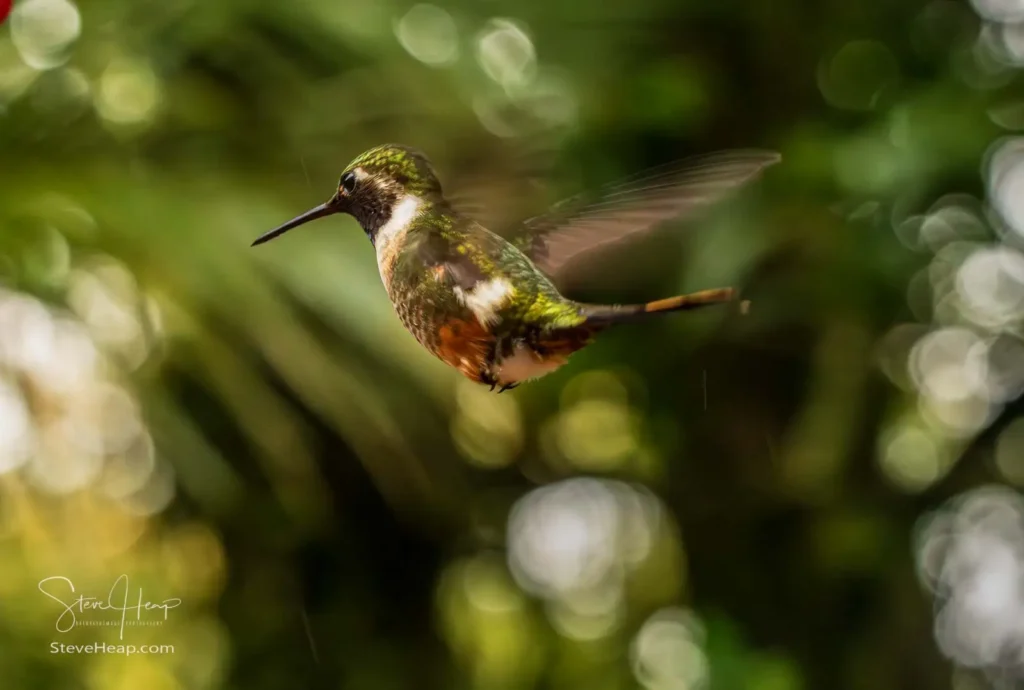
The hummingbird in the image is a female Magenta-throated Woodstar (Philodice bryantae). It is a tiny, bee-like hummingbird with a white patch behind its eye and a white collar across its chest.
Description
- Plumage: The female has bronzy-green upperparts and a grey-buff or whitish throat, lacking the male’s iridescent magenta gorget (throat patch). The flanks and belly have rufous (orange-brown) coloring, which is visible in the image.
- Tail: She has a rounded tail with rufous outer webs and a black subterminal band tipped with buffy-cinnamon, which is shorter than the male’s long, forked tail.
- Size: Females are about 7.5 cm (3 inches) long.
- Behavior: They are known for their slow, bumblebee-like flight and are found in forest edges and clearings where they feed on nectar and small insects.
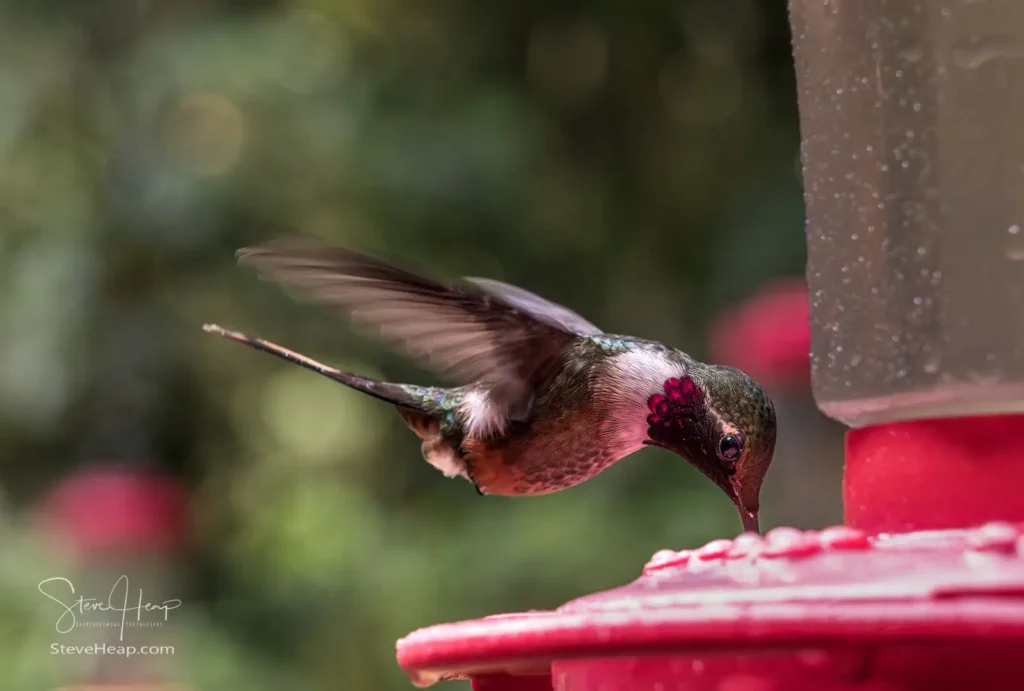
At first, Google AI suggested this was a male Broad-tailed Hummingbird (Selasphorus platycercus). But after further questioning including where the image was taken, we got a different answer.
Based on its range and the specific features of its gorget, the hummingbird in the image is a male Magenta-throated Woodstar (Philodice bryantae), which is found exclusively in the highlands of Costa Rica and western Panama.
| Feature | Bird in Image | Calliope Hummingbird | Magenta-throated Woodstar |
|---|---|---|---|
| Throat Gorget | Solid, iridescent rose-magenta patch. | Distinct individual magenta-red rays that look “streaked”. | Solid, vivid purple throat above a broad white collar. |
| Size | Medium-sized for a hummingbird. | Smallest bird in North America. | Small, similar to a bee hummingbird. |
| Tail Posture | Generally held straight or slightly drooped in flight (as seen here). | Often held very short. | Tail is often cocked upward when feeding. |
| Geographic Range | Breeds in western North America; winters in Mexico and Guatemala. | Breeds in western US/Canada; winters in Mexico. | Endemic resident of the high elevation forests in Costa Rica/Panama. |
Purple-throated Mountain-gem Hummingbird

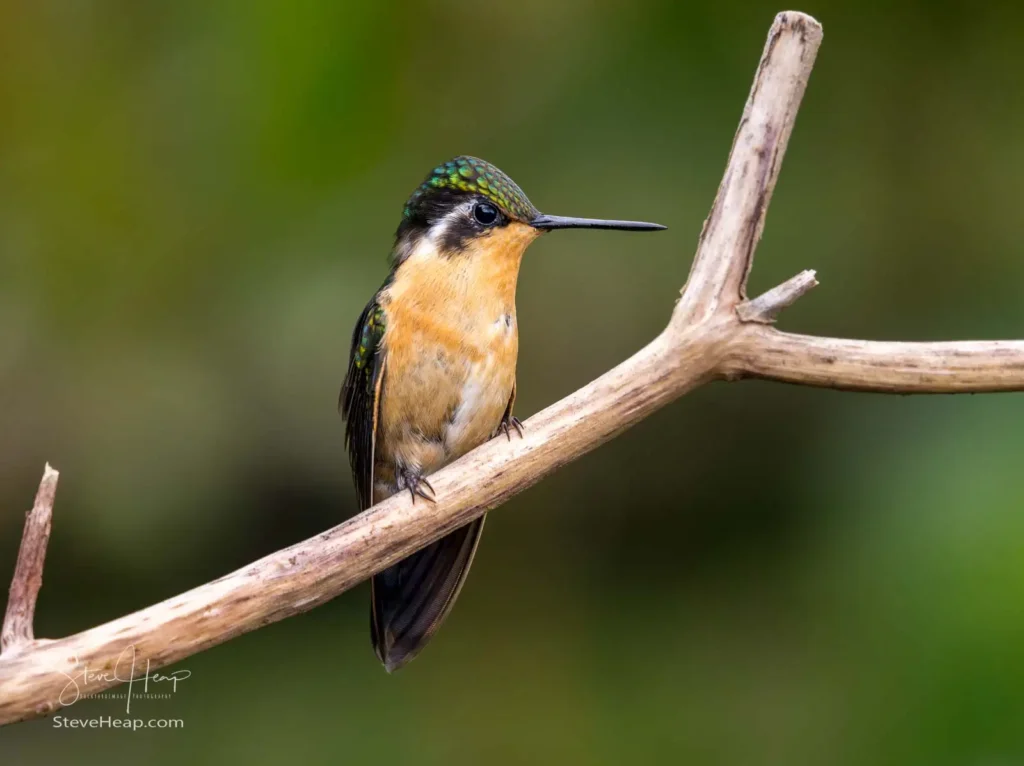
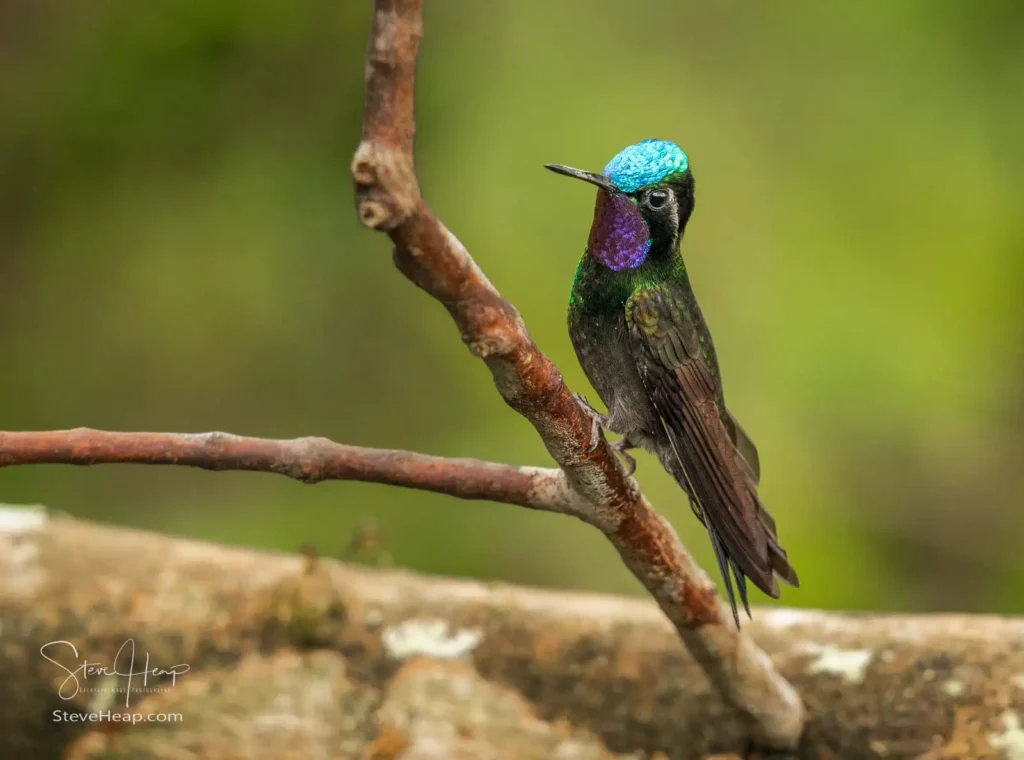
This hummingbird in the top two images is a female Purple-throated Mountain-gem (Lampornis calolaemus). The lower image is of a male with a distinctly different appearance.
- Appearance: The female Purple-throated Mountain-gem has a vibrant green back, a striking orange-yellow belly, and a dark tail with white tips. Males of the species are distinctly different, featuring an iridescent purple throat.
- Habitat and Range: This species breeds in the mountainous regions of southern Nicaragua, northern Costa Rica, and western Panama. They are often found in cloud forests and gardens where they can access nectar.
- Diet: Like other hummingbirds, they primarily feed on flower nectar for energy and supplement their diet with small insects for protein.
- Behavior: Hummingbirds are known for their incredibly fast wing beats, which allow them to hover and even fly backward. They are often very territorial around food sources like the feeder shown in the picture.
Green-crowned Brilliant Hummingbird
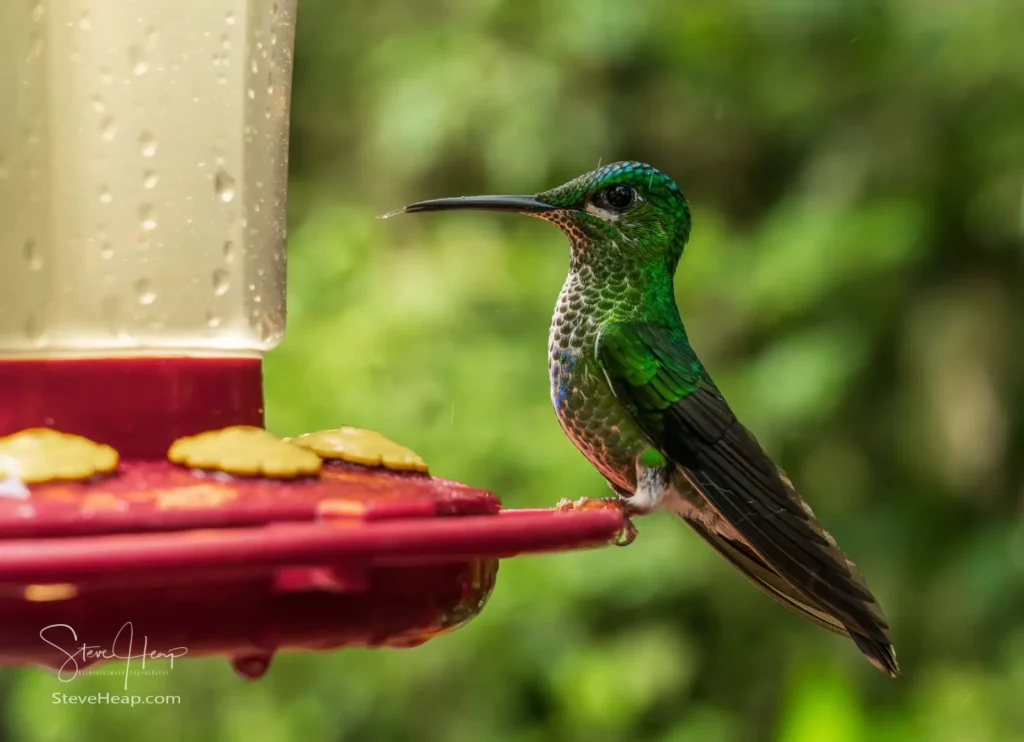
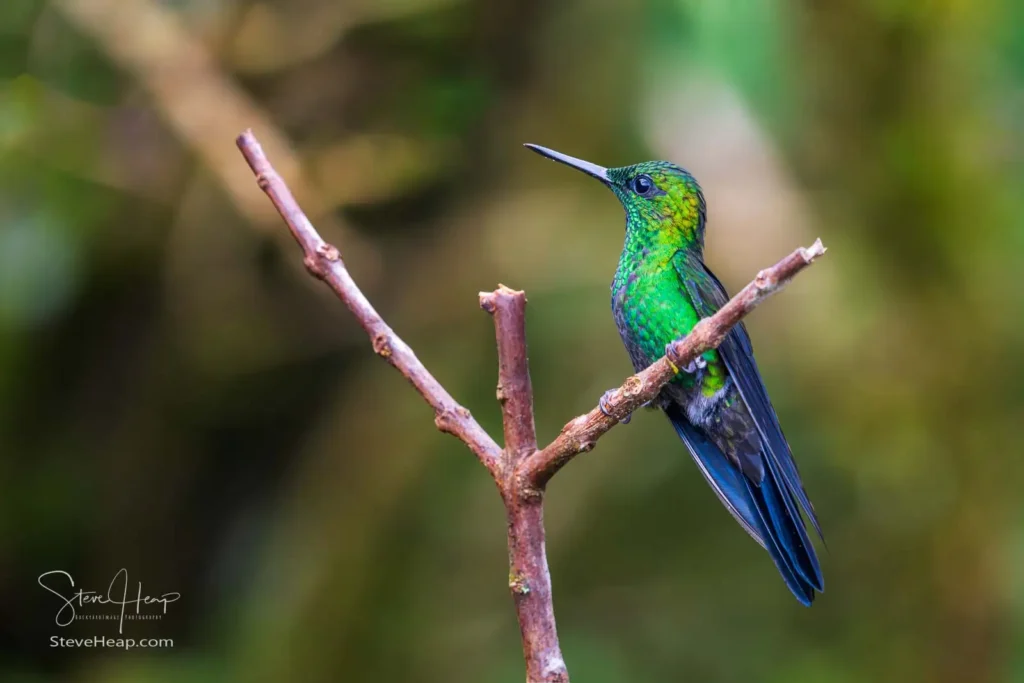
The hummingbird in the upper image is a female or immature male Green-crowned brilliant (Heliodoxa jacula). This species is found in the cloud forests of Costa Rica, Panama, Colombia, and Ecuador. The lower picture is a male specimen.
- Species: Green-crowned brilliant (Heliodoxa jacula)
- Appearance: This individual has a shimmering green crown, bronze-green upper parts, and a grayish-white throat and belly with extensive green spotting or flecking. The tail is dark with white tips on the outer feathers, which is characteristic of the female or immature male plumage.
- Habitat: They inhabit very wet foothill and lower montane cloud forests and forest edges, typically at elevations between 400 and 2,000 meters (1,300 to 6,600 ft).
- Diet & Behavior: They feed on nectar from various flowers, often perching to do so. They also catch small insects and spiders. They are common visitors to hummingbird feeders in specific locations, such as the Monteverde region of Costa Rica.
White-throated Mountain Gem Hummingbird
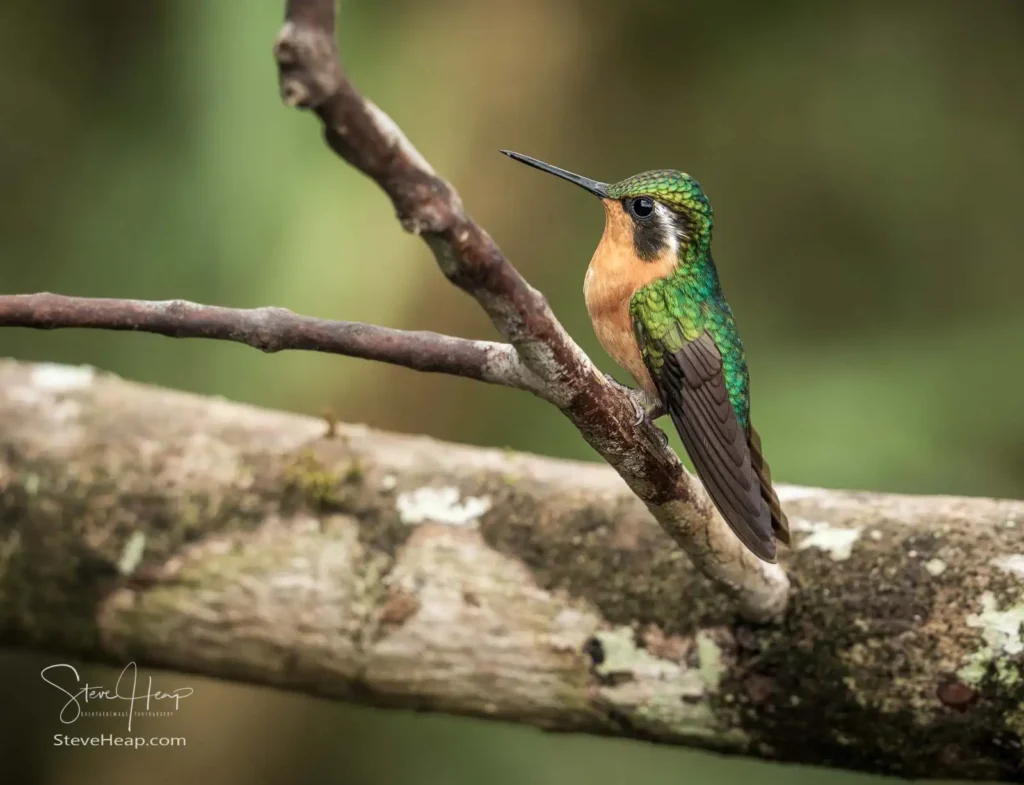
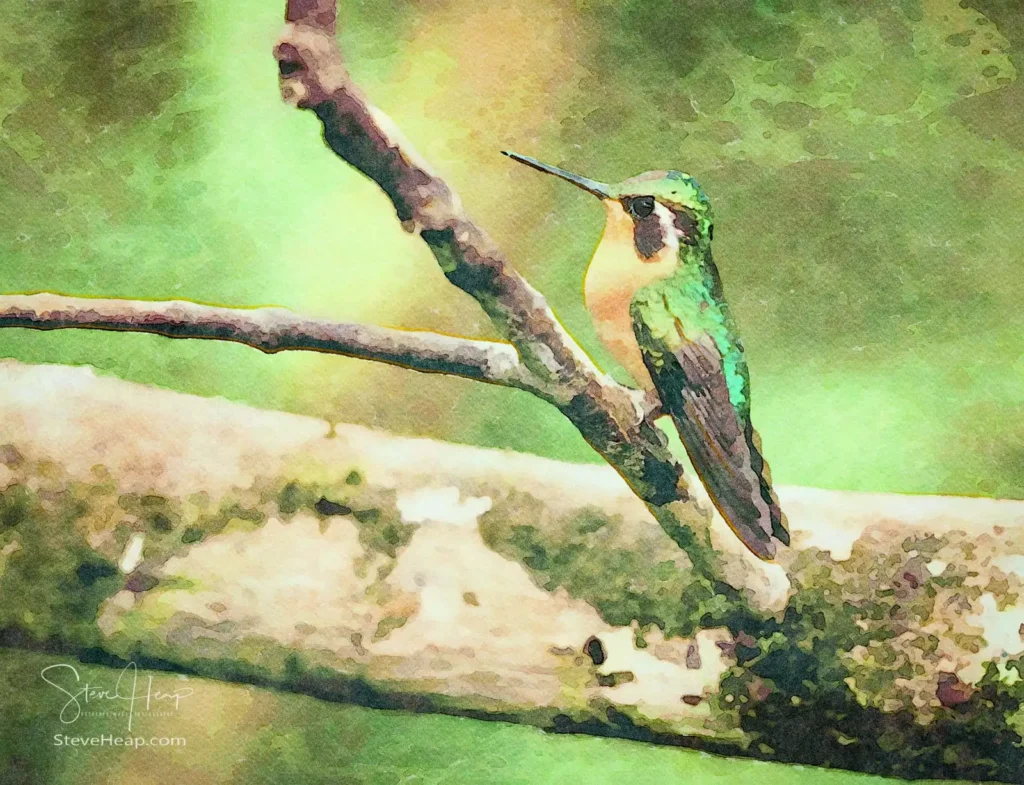
The bird in the image is a White-throated mountaingem (Lampornis castaneoventris), specifically the female or an immature male. This species of hummingbird is found in the highlands and cloud forests of Costa Rica and Panama.
Key Characteristics
- Appearance: Unlike the males which typically have a bright, iridescent purple or white throat patch, females have subtle earth tones on their underparts, which are a dull orange or buff color, along with a pale or whitish throat and a distinctive white line behind the eye. Their upperparts are a bright, iridescent green.
- Habitat: These hummingbirds inhabit mountainous regions and cloud forests, particularly in Costa Rica’s central valley.
- Diet: Like other hummingbirds, their diet consists primarily of nectar from various small flowers, supplemented by small insects for protein.
Mexican or Lesser Violetear Hummingbird
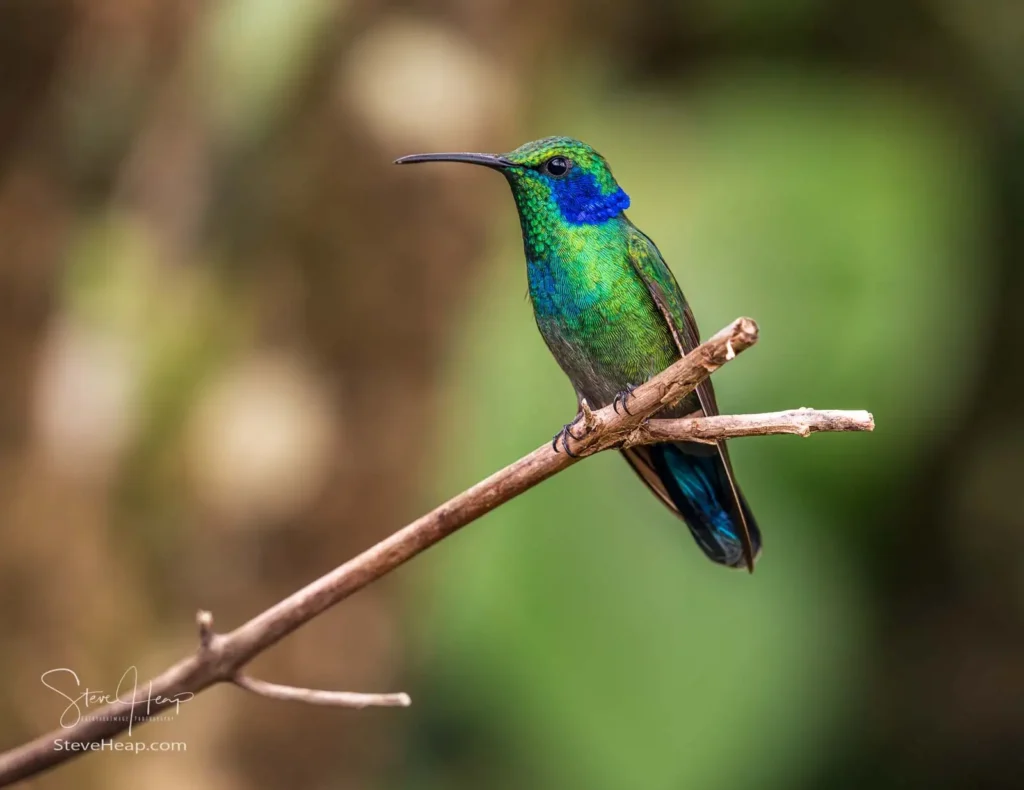
The hummingbird in the image is a Mexican Violetear (Colibri thalassinus), previously known as the green violetear.
Key Characteristics
- Plumage: It has vibrant, iridescent green plumage over most of its body.
- Facial Patch: A glittering violet-blue “ear” patch is visible on the sides of its neck, which can be raised when the bird is agitated.
- Breast Patch: A distinguishing feature of the Mexican Violetear is the blue-violet patch on its breast, which is absent in the very similar Lesser Violetear species.
- Tail: The tail is a metallic blue-green with a prominent black band near the tip.
- Size and Bill: It is a medium-sized hummingbird, measuring around 9.7 to 12 cm (3.8 to 4.7 inches) in length, with a mostly straight, black bill.
Habitat and Distribution
The Mexican Violetear is commonly found in highland forested areas, forest borders, and clearings from south-central Mexico down to Nicaragua. While mostly resident, some individuals may wander north, occasionally appearing as rare visitors in the United States and even Canada.
Conclusion
It’s fascinating to see the different colors and shapes of these birds. I could have taken many more pictures, but it eventually was time to return to the hotel room!
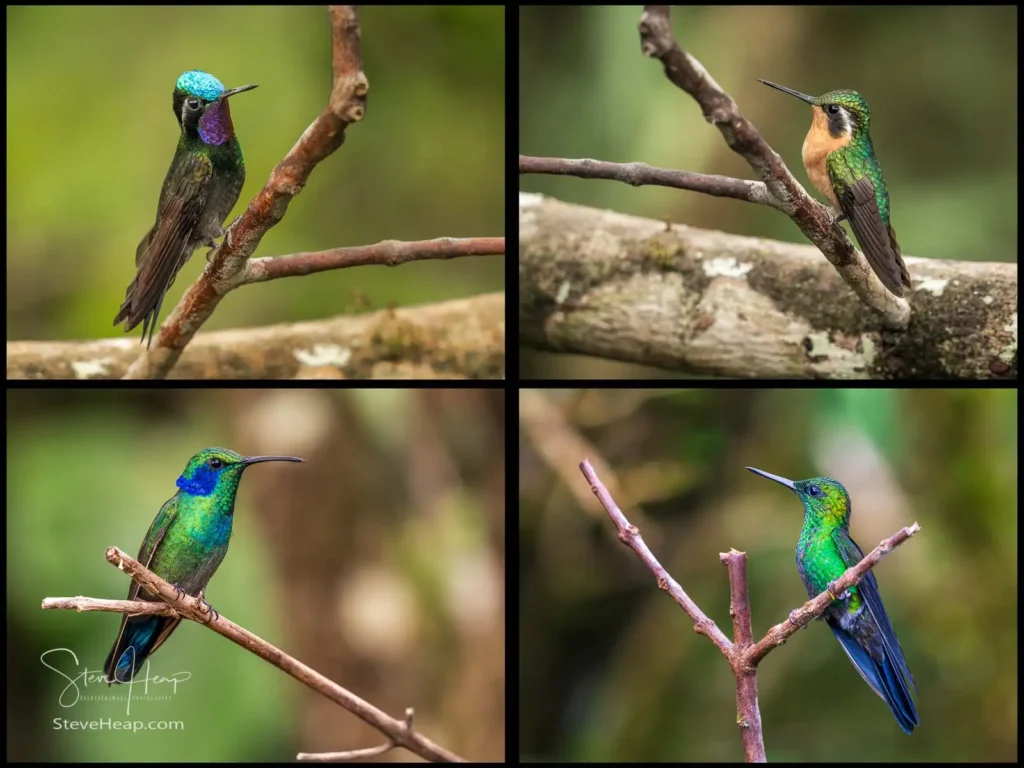
I’ve also created this montage of my four favorite shots from these birds which I thought might be nice as a wall art print.


Milleflore Images
17 Jan 2026Oh, they are so beautiful and colorful, and great capture on all of them, Steve. Beautiful photos, very well done.
Steve Heap
17 Jan 2026Thanks so much! I’ve added that four photo montage to the article now. Will work on more artistic renderings!